
Table of Contents
In the quiet, pre-dawn hours of Besant Nagar, as the first light touches the Bay of Bengal, a group of yogis begins their sun salutations. Meanwhile, in an Alwarpet studio at 7:00 PM, another group moves through a slow, grounding flow to wash away a long day at the office.
This brings us to a question every practitioner eventually asks: Is morning yoga better than evening yoga? In a city like Chennai, where the afternoon heat can be unforgiving and the traffic can dictate our entire day, the timing of your practice is more than just a fitness choice—it’s a lifestyle strategy. Some crave the “Sattvic” (pure) energy of the morning to kickstart their metabolism. Others find that an evening practice is the only way to “defrag” their brain after a high-pressure shift in the OMR tech corridor.
There is no “wrong” time for yoga, but there is an “ideal” time for your specific goals. Whether you want to wake up your spine or shut down your stress, understanding the biological and practical differences between AM and PM practice will help you build a habit that actually lasts.

| Feature | Morning Yoga (AM) | Evening Yoga (PM) |
| Body State | Stiff joints, empty stomach | Flexible muscles, high mental load |
| Primary Goal | Energy, focus, metabolism | Stress relief, flexibility, sleep |
| Nervous System | Activates Sympathetic (Alertness) | Activates Parasympathetic (Rest) |
| Chennai Factor | Best for beating the heat/humidity | Best for unwinding after traffic |
| Ideal Styles | Surya Namaskar, Vinyasa, Hatha | Yin, Restorative, Yoga Nidra |
Choosing between morning and evening yoga isn’t a flip of a coin. To make it stick, you need to evaluate your life through three specific lenses:
Are you a “Early Bird” or a “Night Owl”? If you naturally wake up at 5:00 AM, forcing yourself to stay alert for a 7:30 PM power yoga class will feel like a chore. Conversely, if you struggle to see straight before your first cup of filter coffee, a sunrise beach session might be too jarring for your system.
Do you have a “front-loaded” day? If your job involves back-to-back meetings starting at 9:00 AM, a morning practice provides the mental armor you need. If your job is physically sedentary (desk-bound), an evening practice is essential to release the physical tension stored in your hips and lower back.
If your primary goal is weight loss and digestion, morning yoga on an empty stomach is scientifically superior. If your goal is flexibility and injury recovery, your muscles are warmer and more pliable in the evening, allowing for deeper stretches with less risk.
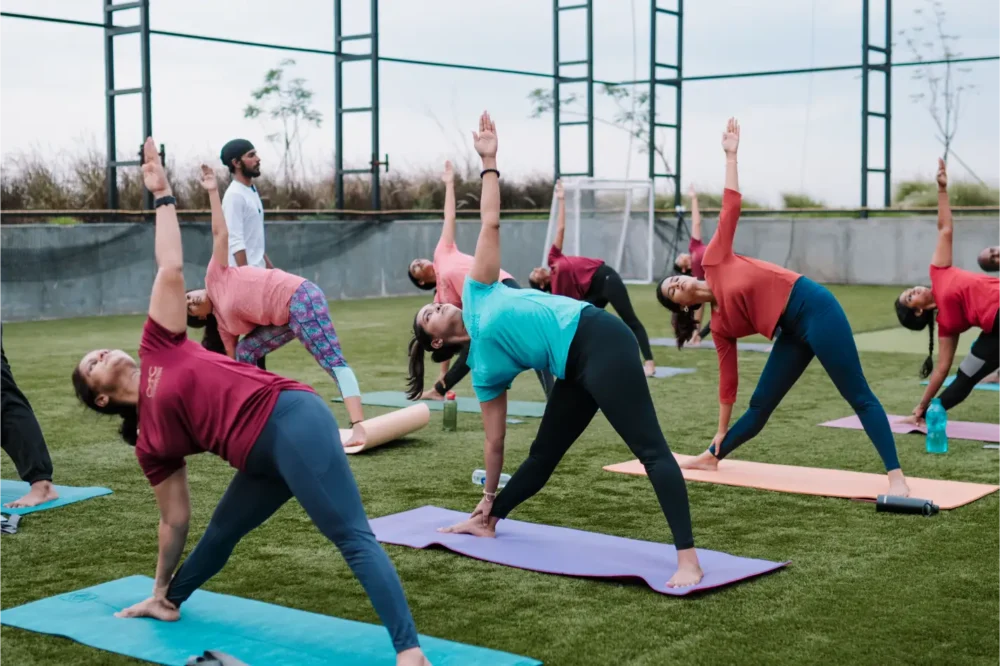
Morning yoga is traditionally known as Brahmamuhurtha practice—the time of the creator. In Chennai, this is the only time the air feels truly crisp and the city noise is at a minimum.
- The Biological Edge: Practicing in the morning boosts your endorphins and sets your circadian rhythm. Exposure to early morning sunlight (especially at the beach) helps regulate your sleep-wake cycle.
- The Mental Edge: It provides a “win” before the day even begins. When you’ve already conquered a challenging balance pose by 7:00 AM, the stress of the Chennai commute feels much more manageable.
- The Practical Edge: Morning yoga is rarely canceled. In the evening, “life happens”—late meetings, family visits, or sheer exhaustion often get in the way.
Evening yoga is about the “un-doing.” It is the process of peeling off the layers of the day.
- The Biological Edge: Your body temperature peaks in the late afternoon. This means your muscles are at their most elastic. You will likely find that your “downward dog” feels much deeper at 6:00 PM than it did at 6:00 AM.
- The Mental Edge: It acts as a cognitive “reset button.” It creates a clear boundary between your professional life and your personal life.
- The Practical Edge: For those with digestive issues, a gentle evening practice (at least 2 hours after a light snack) can stimulate the digestive tract and prevent bloating.
- Pros: Boosts metabolism, enhances mental clarity, beats the Chennai heat, ensures consistency.
- Cons: Higher initial stiffness, requires a very early wake-up call, limited time if you have an early commute.
- Pros: Superior flexibility, excellent stress relief, aids deep sleep, helps release “office-body” tension.
- Cons: Can be easily skipped due to tiredness, might interfere with sleep if too intense (Power Yoga), studio classes may be crowded.
- Beginners: Morning Yoga is often better. It establishes discipline and allows you to learn basic alignment when your mind is fresh and uncluttered.
- IT & Corporate Professionals: Evening Yoga. You need to move those joints after 8 hours of sitting. A restorative evening flow is the antidote to “corporate burnout.”
- Athletes & Runners: Evening Yoga. Use it as a recovery tool to stretch out tight hamstrings and calves after your evening run or gym session.
- Stress Relief Seekers: Either, but prioritize Yoga Nidra in the evening. If anxiety keeps you up at night, an evening practice focused on breathwork is transformative.
In Chennai, the “value” of yoga often depends on your commute.
- Morning Value: Outdoor yoga groups (like those at Nageswara Rao Park or Besant Nagar) are usually more affordable (₹1,500 – ₹3,000/month). The “value” includes free Vitamin D and fresh air.
- Evening Value: Boutique studios in areas like Anna Nagar or Adyar often have more evening slots but may charge a premium (₹4,000 – ₹6,000/month) for the convenience of AC and post-work showers.
If you are practicing Online, the cost is the same, but the “value” of morning yoga increases because you can literally roll out of bed and onto your mat, saving 100% of commute time.
- Forcing the “Early Bird” Narrative: Don’t assume morning yoga is the only way to be a “real” yogi. If you hate mornings, forcing it will lead to burnout.
- Doing “Power Yoga” Too Late: Practicing high-intensity Vinyasa at 9:00 PM can spike your heart rate and keep you awake. Stick to “Lunar” (calm) practices after sunset.
- Ignoring the Empty Stomach Rule: Whether morning or evening, practicing yoga immediately after a heavy meal of Sambar Rice or a Masala Dosa is a recipe for acid reflux. Always wait 2-3 hours after a main meal.
Arun works in Sholinganallur. His mornings are a rush of school drops and traffic. He tried morning yoga but was always looking at the clock. He switched to a 7:00 PM virtual Hatha class. Now, he uses that hour to transition from “Boss Mode” to “Dad Mode.” He sleeps better and his lower back pain has vanished.
Deepa found that her afternoons were sluggish. She started a 6:00 AM outdoor yoga group. The cool morning air and social connection with her neighbors gave her a sustained energy boost that lasted until 4:00 PM, eliminating her need for a mid-day nap and a third cup of coffee.

1. Is it okay to do yoga twice a day?
Yes, but balance the intensity. For example, an active Vinyasa in the morning and a 15-minute restorative session or meditation in the evening is a perfect holistic combination.
2. Should I eat before morning yoga?
Ideally, practice on an empty stomach. If you feel faint, a few almonds or half a banana 30 minutes before is fine.
3. Does evening yoga help with weight loss?
While morning yoga is better for fat oxidation, evening yoga helps by lowering stress-related cortisol, which is a major contributor to belly fat.
4. Can I do “Sun Salutations” (Surya Namaskar) in the evening?
Yes, but perform them at a slower pace. In the morning, they are meant to wake you up; in the evening, they can be done as a mindful moving meditation.
5. Which is better for the Chennai summer?
Morning is significantly better. By 6:00 PM, the city has been baking all day, and indoor studios can feel stuffy, while outdoor spaces are still radiating heat from the ground.
6. I have insomnia; when should I practice?
Evening. Specifically, look for “Yin Yoga” or “Yoga Nidra” between 7:00 PM and 9:00 PM to prime your nervous system for deep sleep.
The “best” time for yoga is the time you can commit to 3 days a week.
If you want to feel powerful and focused, Morning Yoga is your ally. If you want to feel peaceful and physically open, Evening Yoga is your sanctuary. In Chennai, we are blessed with a culture that supports both—from sunrise beach groups to late-night virtual sessions.
Next Step: Try a “Split Week.” Do two mornings and two evenings this week. Notice which one leaves you feeling more “in your flow.”
Would you like me to suggest a 15-minute beginner sequence specifically for the morning or the evening based on your choice?
